Are you thinking of investing in a Nima device? Before you do, read my take on this important yet controversial portable gluten-detecting device. I am a nutrition professional specializing in celiac disease and gluten disorders. I do not work for Nima, but in January 2026, years after I wrote this article, I joined Nima as an affiliate. This post contains affiliate links. Please see my disclosures.
January 2026 Update: A New Chapter for Nima
It’s been several years since I last updated this article, and there have been significant changes worth addressing.
As of January 2026, Nima has officially relaunched under a new company called Nima Now. Over the years, the brand has gone through multiple iterations — originally launching as Nima Sensor, later becoming Nima Partners after its acquisition, and now emerging under new ownership and leadership as Nima Now.
I want to be very clear: this relaunch matters.
For the first time in a long while, I’m genuinely encouraged by the direction Nima is taking and the effort being made to rebuild trust within the gluten-free community. Transparency, reliability, and accountability are non-negotiable when it comes to tools that people with celiac disease depend on — and the new leadership appears to understand that.
In a January 2026 press release, the company stated:
“This relaunch is different. It isn’t a restart. It’s a new foundation, built to ensure NIMA can be trusted, available, and dependable for the long term.”
That’s a strong statement — and one I take seriously.
I’ve published a new, in-depth Nima article on January 14, 2026 that walks through what has changed, what’s actually different this time, and whether I believe Nima is truly worth a second look.
Original Article:
The gluten-free world has been buzzing about portable gluten-detecting devices like Nima and LEO testers — and with good reason. For people living with celiac disease or strict gluten intolerance, even a small amount of hidden gluten can have real consequences.
When used correctly and within their limitations, these devices can offer an added layer of information — particularly when navigating restaurants, shared kitchens, or foods with unclear labeling. They don’t replace gluten-free certification, ingredient labels, or informed conversations with food staff, but they can help reduce some of the uncertainty that comes with eating outside your own kitchen.
As more gluten-detecting devices enter the market, the idea of blindly trusting a dish placed in front of you feels increasingly outdated. Instead of guessing whether that burger bun, sauce, or side dish is truly gluten-free, a portable sensor can provide data within minutes — information that many people in the gluten-free community find empowering.
Before diving into the pros, cons, limitations, and ongoing criticisms of Nima, let’s first take a step back and look at what this device is, how it works, and what it can — and cannot — realistically do.
What is Nima?
Nima is a portable gluten-detecting device designed to help people identify hidden gluten in food — particularly in restaurant dishes or foods with unclear labeling. When it launched in 2017, it quickly became the first consumer-facing device of its kind and sparked widespread conversation within the gluten-free community.
I was one of the earliest users of Nima and shared my very first test live on Facebook. At the time, the idea that you could test your actual meal — right at the table — felt revolutionary.
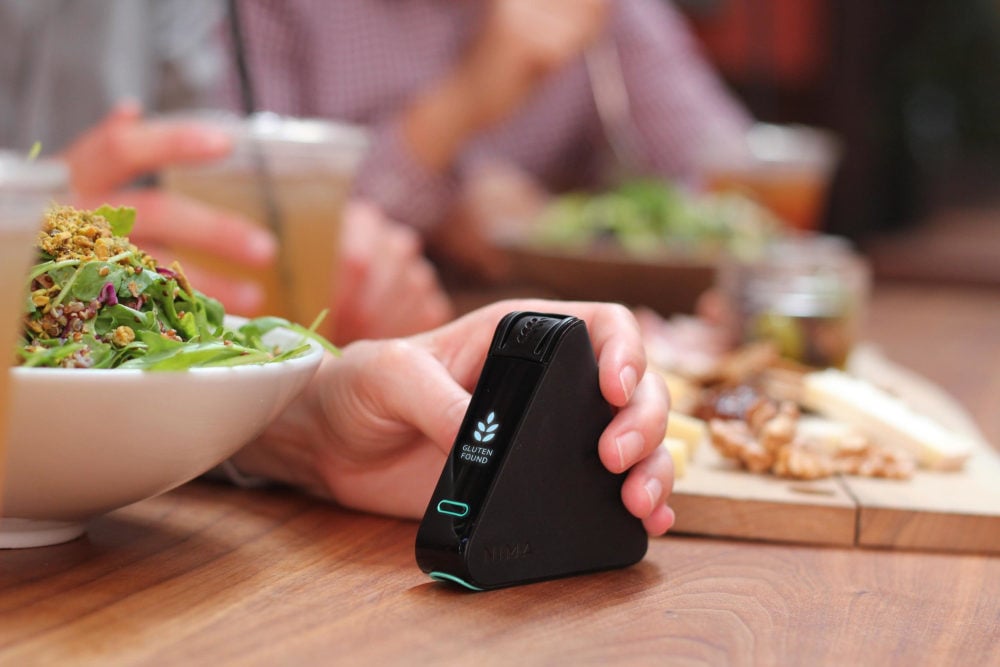
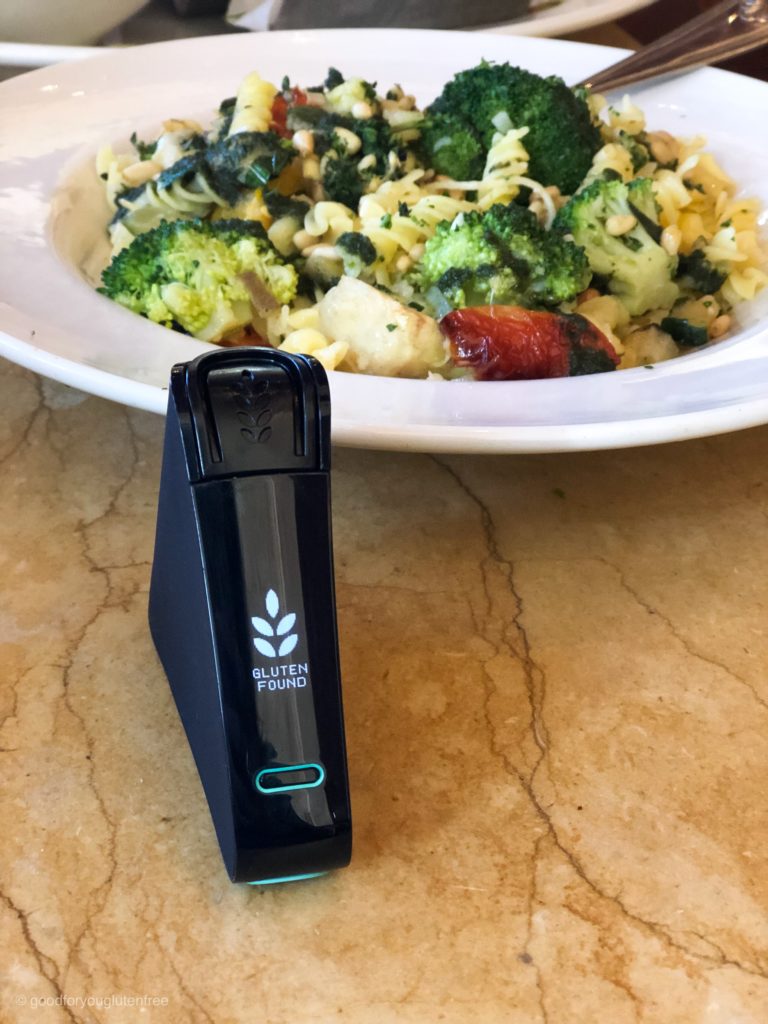
Using Nima is straightforward. You place a small sample of food into a single-use test capsule, insert the capsule into the triangular Nima device, and wait about 2–3 minutes. The device then displays one of two results:
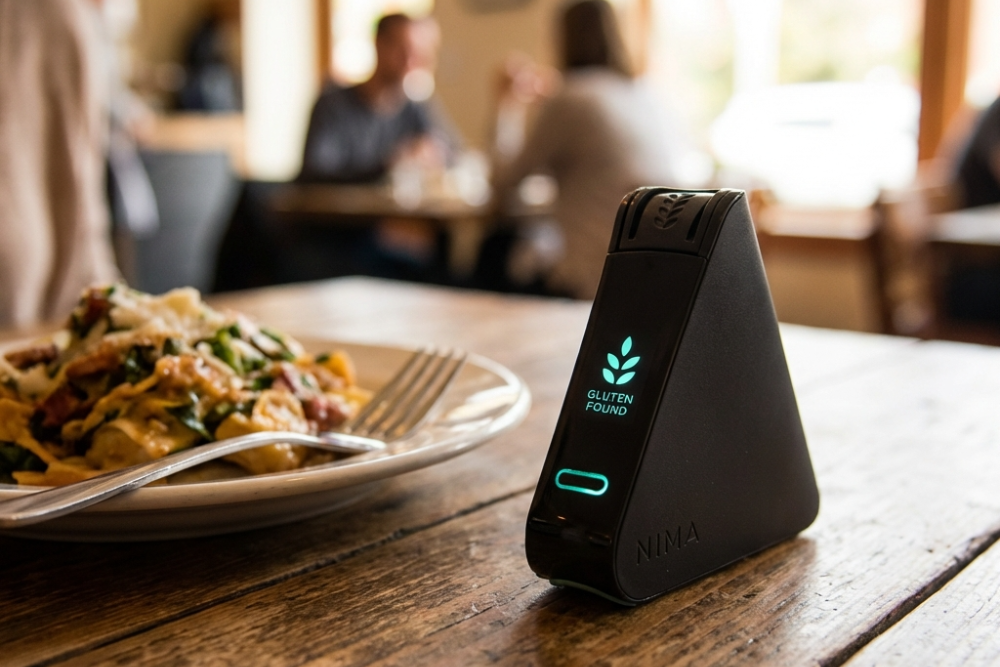
- A wheat icon if gluten is detected
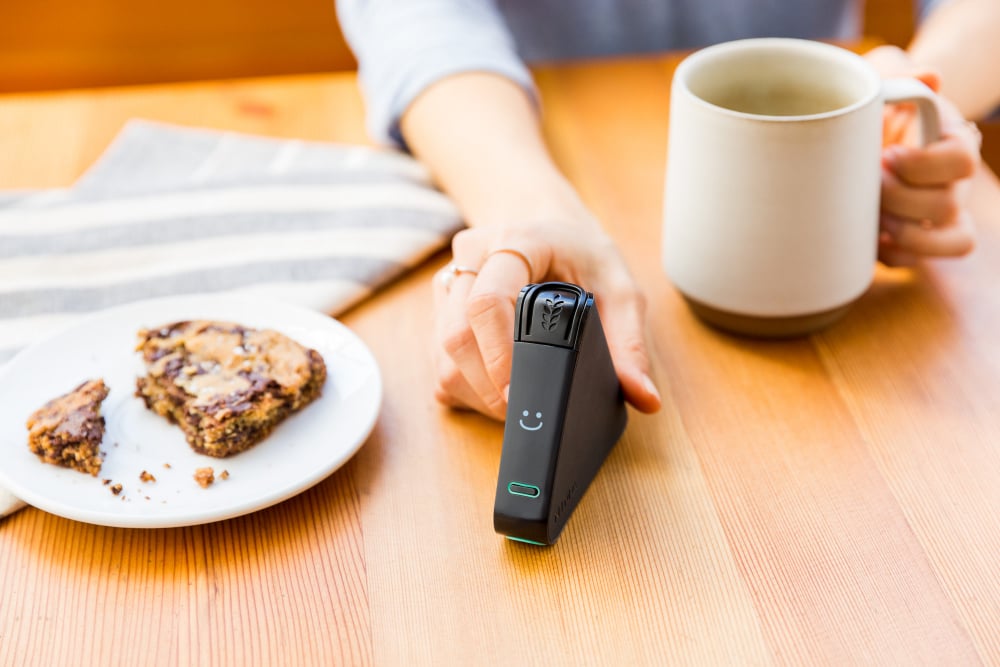
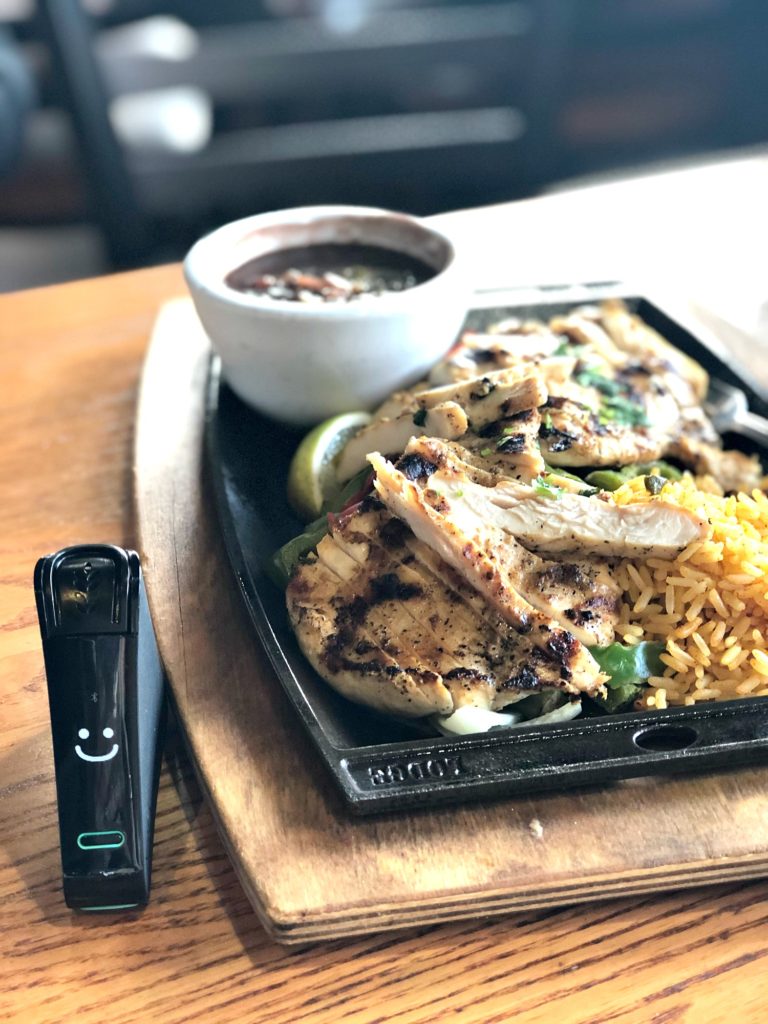
- A smiley face if no gluten is found at or above Nima’s detection threshold
What makes Nima compelling is that it allows you to test the exact food in front of you, rather than relying solely on ingredient lists, assumptions, or conversations that may leave room for error. In many ways, it functions like a miniature gluten-testing lab you can carry in your purse or pocket.
Nima’s tagline is “Bringing peace of mind to mealtime,” and when used appropriately, that’s exactly what it has done for me. It has helped me feel more confident eating outside my home and reduced the constant second-guessing that often comes with managing celiac disease.
And yes — it has absolutely helped me spend less time in what I jokingly call “gluten-free jail.”
Eating out is one of the most anxiety-provoking parts of living gluten-free, and for good reason. Even well-intentioned restaurants can struggle to prepare truly safe meals.
According to Nima Sensor data, 35% of restaurant meals labeled “gluten-free” tested positive for gluten. That aligns with a Good For You Gluten Free survey, where 85% of respondents said eating out is their biggest challenge.
Still, I refuse to give up dining out, traveling, or spending time with friends. Food is central to social life, and I won’t let my diagnosis keep me on the sidelines.
Instead of opting out, I’ve chosen to use tools — including Nima — to add an extra layer of information when eating outside my home. I’ve also seen firsthand how confusing food labeling can be, with Nima detecting gluten in some products labeled gluten-free.
Nima is a polarizing device. Some critics are outspoken, while thousands of people rely on it to navigate daily life with more confidence.
My goal isn’t to persuade you — it’s to inform you. With a clear understanding of the benefits, limitations, and criticisms, you can decide whether Nima is a tool you want to use or one you’d rather skip.
Is Nima Accurate?
Many people question the device’s accuracy and whether its “hyper-accuracy” is a pro or con.
Some critics say Nima gives too many false positives, which can be true, but you need to understand what that means before you judge “false positives” as a pro or con.
A false positive can mean one of two things.
First, a true “false positive” can happen when a user tests brightly colored foods, powdered foods, and thick or dense foods. You can read more about these specific limitations in the Nima User Manual.
Below are three incidents where I believe I experienced true Nima false positives:
- I received a false positive when I tested Jovial’s Vegan Mac, which, after Jovial sent the product for further testing, came back with no detectable levels of gluten. The bright yellow cheese packet triggered the false positive.
- I also believe I received a false positive when I tested Food For Life Gluten-Free English Muffins, which I independently tested in a lab at my own expense, and no gluten was found.
- I believe I received a false positive when I tested cumin spices, which are brightly colored and powdered. I also think my testing of Tajin spice may be wrong as well for the same reasons.
However, when critics refer to “false positives,” they aren’t always referring to the outlier examples noted above.
Instead, a “false positive” can also mean Nima is detecting gluten below the legal 20 parts per million (ppm) threshold. This comes to issue because the FDA says a product can be labeled “gluten-free” if it contains 0-19 ppm of gluten.
You may not have realized that foods can legally contain a small amount of gluten and still be labeled “gluten-free.” If you’re concerned that the 20 ppm gluten threshold isn’t enough, read, Is the FDA’s 20 ppm Gluten Threshold Enough? to broaden your understanding of this ruling.
Let’s say a product contains 19 ppm of gluten, Nima will likely display a “gluten found” message.
In fact, Nima says it will report “gluten found” 96.8 percent of the time when the level of gluten is 20 ppm or greater (FDA legal limit), it will report “gluten found” 56 percent of the time when the level of gluten is 10 ppm, and 35 percent of the time when it finds 5 ppm of gluten. This is what some critics refer to as “false positives.”
As you can see, Nima is highly accurate at detecting gluten below the 20ppm legal limit. This makes the device far from perfect, but I believe no one should let perfection be the enemy of good.
I once asked the original founder of Nima, Shireen Yates, why Nima displays a “gluten found” message when it finds gluten under the legal 20 ppm threshold.
She said that the company faced an ethical dilemma. Should Nima display a “gluten found” message when it finds any gluten? Or just say a product is “gluten-free” even if it contains some detectable gluten? They chose to go the route of complete transparency.
Unfortunately, Nima cannot tell you the exact parts per million of gluten it detects in a product; it can only display a smiley face if it doesn’t detect gluten or a “gluten found” message if it does. Would you still eat something if Nima said it contained 11 ppm of gluten? How about 18 ppm of gluten? I know this nuance would matter to me.
Hopefully, Nima will develop technology to report the exact amount (ppm) of gluten found, so the user knows whether Nima detected 11 ppm or 24 ppm of gluten. This would empower someone to make a more informed choice.
Does Nima Promote Hypervigilance?
Some critics of Nima say the device promotes hypervigilance, can lead to disordered eating, and puts you in food jail. While I understand this criticism, the logic is slightly twisted. (BTW, several critics who use this argument have never used Nima nor spoken to someone like me who has used it successfully for years.)
Most people in the gluten-free community have real food fears, anxieties, and trust issues when it comes to eating out. Why? They still feel sick despite eating gluten-free labeled foods or ordering a gluten-free meal.
People on a gluten-free diet often feel sick to their stomachs and deal with the long-term repercussions of not being fully compliant with the gluten-free diet despite their best efforts to eat strictly gluten-free.
This is where Nima can shine. It can give you food freedom, helping you trust products and restaurant dishes because you have an actual tool at your fingertips to decode what’s inside your meal.
While some will call that “hypervigilance” and label it a “bad” thing, I think others could see it as a mark in the pro column for how Nima can get you out of food-fear jail.
Keep in mind, however, that when eating out, it can be extremely stressful to test your food. If the result is “gluten found,” you’ll have to have those uncomfortable conversations with the waitstaff. It’s also why I no longer use my Nima device inside restaurants – the anxiety is too much for me.
In a roundabout way, Nima presents an ethical dilemma to the gluten-free community. Is it better to know if your food contains gluten? Or is ignorance bliss?
If you choose not to know, are you accepting that restaurants will get it wrong? Or if you test your food and find gluten, are you holding restaurants to a higher standard and making things better for the gluten-free diners that patronize that restaurant next?
Nima Can’t Test Some Foods
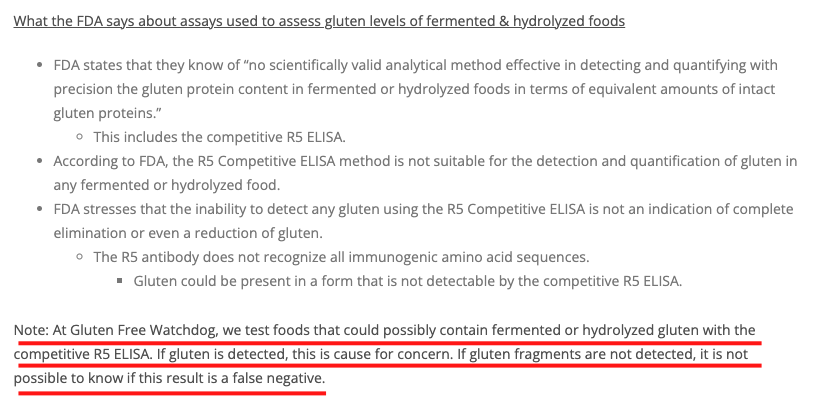
A significant limitation of Nima is that it cannot test for gluten in some foods. The FDA says there is “no scientifically valid analytical method effective in detecting and quantifying with precision the gluten protein content in fermented or hydrolyzed foods in terms of equivalent amounts of intact gluten proteins.”
When using Nima – or consuming any product that contains hydrolyzed (malt) or fermented ingredients, even if labeled “gluten-free” – you must be fully aware of these limitations.
- Nima cannot detect gluten in fermented foods, such as beer, vanilla extract, alcohol, or gluten-removed beers.
- Nima cannot detect gluten in hydrolyzed foods such as soy sauce and malt extract/flavoring.
- Nima has not been validated to test medications, cosmetics, or non-food items. (Although I have “illegally” used it to test Zyrtec.)
- Nima cannot detect gluten in PURE xanthan or guar gum.
For example, if a product contains barley malt or hydrolyzed wheat, Nima may not find gluten. One influencer was attacked by the gluten-free community for mistakenly testing McDonald’s French fries for hidden gluten; she didn’t check the ingredient list, which clearly stated the fries contained hydrolyzed wheat. Because Nima and no commercial testing lab can accurately detect hydrolyzed wheat, Nima displayed a smiley face.
One of the most important skills a person on a gluten-free diet can master is label reading, which you can learn more about in my article, What Gluten-Free Labeling Laws and Certifications Really Mean. Once you know a product doesn’t contain any gluten ingredients, you can then proceed to test it with Nima.
Even the widely used R5 ELISA testing method by The Gluten-Free Watchdog has limitations.
The Watchdog says, “At Gluten Free Watchdog, we test foods that could possibly contain fermented or hydrolyzed gluten with the competitive R5 ELISA. If gluten is detected, this is cause for concern. If gluten fragments are not detected, it is not possible to know if this result is a false negative.” Below is a screenshot taken directly from the Watchdog’s website:
This is why many people in the gluten-free community advocate for U.S. food manufacturers to disclose barley on food labels. Read Beware of Malt and These 21 Potential Sources of Barley (Gluten) for more information on this important topic.
Furthermore, Nima recommends diluting powdered foods, brightly colored foods, and thick, dense foods with water to reduce testing errors and obtain more accurate results.
Nima Can Only Test a Small Amount of Food
Nima can only test a pea-sized portion of your food, which critics say can create unreliable results due to hot spots, which is true.
If one part of your food tests gluten-free, you still may not know whether the whole dish is safe. While it would be nice to be able to send your entire meal to a lab for full-on testing, it’s just not possible.
One strategy I employ is to rub the piece of food I will test over other parts of my food, particularly on grill lines and parts that seem like they could have come in contact with gluten. This gives Nima a more accurate picture of the whole dish vs. just one tiny sample.
Remember, Nima is not a substitute for lazy ordering or for being overly trusting of restaurants. You must still order meals that are least likely to come into contact with gluten if you genuinely want to eat out safely. This means avoiding items like pizza and pasta due to the potential for cross-contamination, even if you test them with Nima.
To learn my strategies for eating out as safely as possible, read The Ultimate Guide to Eating Out Gluten-Free.
Nima is Expensive!
Nima is not cheap. Last I checked, the Nima device costs $220 on the Nima Now website and $72 for six single-use test capsules. Each test requires one single-use test capsule. This means it can cost more to test your food than the food costs itself!
If you test a $5 hamburger, you can tack on another $12 to the price tag!!
One critic says those who use Nima must recognize our “privilege.” I hate that word and find it insulting and demeaning. However, I recognize that I’m in a rare position to afford capsules.
I’ve committed to sharing most of my tests with my community via my weekly newsletter, which I highly recommend you subscribe to. Also, 90 percent of what I test is at the request of my community. I don’t charge anyone to see my test results.
I also hold restaurants and manufacturers accountable, which makes the entire industry better and benefits both those who can and cannot afford Nima.
Unfortunately, gluten-free foods cost more than regular food, which is a problem. Instead of calling those who use Nima “privileged,” critics should focus their energy on helping reduce the costs of medically necessary gluten-free food. Some countries, like Italy, give vouchers to those with celiac disease to offset the high cost of gluten-free food.
The Canadian Celiac Association Doesn’t “Recommend” Nima
What annoys me is the unfounded statement the Canadian Celiac Association has made against the Nima.
They say they don’t “recommend” the device because they don’t believe people are smart enough to use it, given its limitations and the complexities of food testing. It’s an unfortunate statement that has not only damaged Nima but also insulted the gluten-free community.
I have a few words for the Canadian Celiac Association in this article.
The truth is, Nima is not that complicated once you learn how to use it, just like pregnancy tests are not complicated when used as instructed.
Instead of telling an entire community they’re too stupid to use it correctly, the CCA should focus on educating the gluten-free community on how to use it safely and how it can and should be used to help everyone eat safely.
Having a Nima can be empowering to so many people. And if you’ve used it for years, you know it’s a device you don’t want to live without.
Nima vs. Gluten-Free Watchdog
The Gluten-Free Watchdog sends full products to a testing lab to determine if they contain gluten. You can pay the Gluten-Free Watchdog a $6.99 monthly subscription fee to view test results for a handful of products the site owner tests each month.
Once you pay to subscribe, the Gluten-Free Watchdog says you’ll receive approximately $2,000 worth of new testing data each month. This claim highlights just how EXPENSIVE testing can be if you don’t have a Nima.
I subscribed to the Gluten Free Watchdog and found the tests helpful, but, truthfully, I also found them to be for products I never eat and nor have heard of.
Plus, the Watchdog’s tests say little about the actual restaurant dish or packaged food I’m about to eat. I use Nima to test the exact food at the end of my fork. Now that’s empowering!
The Gluten Free Watchdog has come out strongly against Nima, citing that Nima creates too many false positives. Remember, Nima displays a “gluten found” message 56 percent of the time when the level of gluten is 10 ppm, and 35 percent of the time when it finds 5 ppm of gluten. And there are true incidents of false positives as noted above. This device is far from perfect.
I also think people should take The Gluten-Free Watchdog’s criticism of Nima with a grain of salt after weighing the pros and cons of the device and the costs of a Gluten Free Watchdog subscription.
Update (Nov. 2022): Members of The Gluten-Free Watchdog community have been asking The Gluten-Free Watchdog to further test products they’ve first tested with Nima.
For example, it was a Nima user who notified The Gluten-Free Watchdog that her personal Nima found gluten in GF Harvest oats, which then prompted The Gluten-Free Watchdog to conduct further lab testing.
A Nima user also alerted the Watchdog that this Oklahoma bakery was selling gluten-free products made with wheat flour!
So maybe Nima has some merits, even to its loudest critics, eh? The hypocrisy is palatable.
Nima Errors
One of the most annoying parts of using Nima is when it returns an error message. Sometimes, you can look at the back of the test capsule to see what the pink lines reveal, but this isn’t a reliable method.
The first pink line indicates the capsule worked; the second pink line indicates “no gluten found,” while the third pink line indicates “gluten found.” Sometimes the third pink line is very faint.
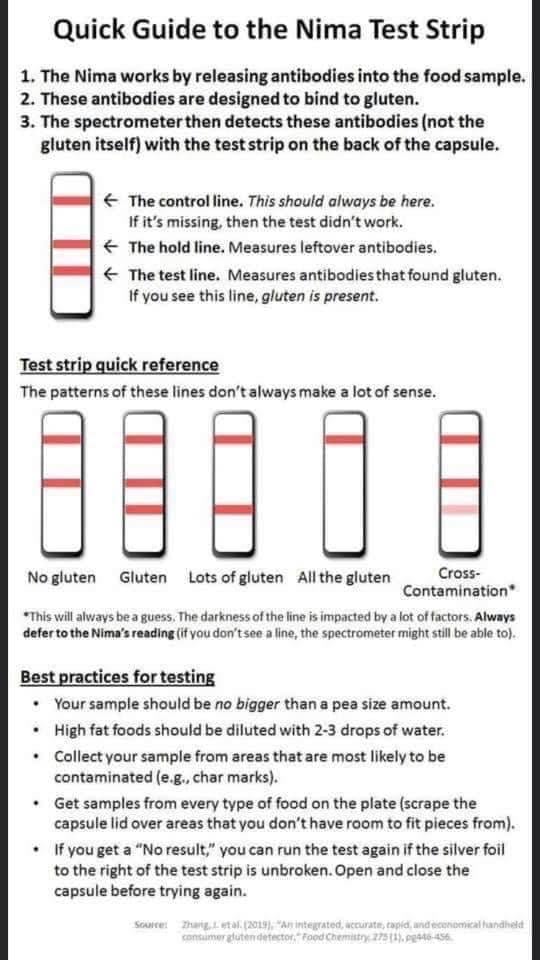
If you get an error message, take a picture and send it to the Nima customer support email. They may issue you a credit or send you a new capsule.
Want Me to Address Another Pro, Con, or Limitation?
Just when I thought I had addressed all the pros, cons, and limitations, someone would come up with another reason to love or hate the Nima.
Let me know what you’ve heard because I would love to add to this article and ensure we’re spreading facts, not fear, about Nima.
If you’d like a Nima of your own, visit Nima Now online to shop.
Additional Reading
- Nima’s Return in 2026 — What You Need to Know
- Nima Sensor Controversy Boils Over When Influencer Puts McDonald’s French Fries to the Hidden Gluten Test
- Canadian Celiac Association vs. Nima Sensor: Why I Stand With Nima
- The Allergy Amulet Gluten Detecting Device
- Did Nima Sensor Go Out of Business?
- What Ice Creams are Gluten-Free [Nima Sensor Tested]
- Ultimate Guide to Eating Out Gluten Free ebook
Only Nima capsules can be used with Nima devices
Hi. What do the Nima gluten tester capsules look like? Could you use other capsules in it?
-Holly.
Thank you for the update and including the original article. I think that shows you are a person of integrity. If I were in your position, I would also part ways with Nima. Hopefully technology will get better and cost will come down in the future, like with many of the gadgets we all enjoy today. Wishing you all the best.
I wouldn’t test something that says may contain wheat. There might be a GF alternative??
Nesquik!
My son was diagnosed with celiac after we had all the children screened, after their dad’s diagnosis. We stopped buying Nesquik because it has a “may contains wheat” warning on it. I assume this is due to potential cross-contamination in processing. He is not very sensitive to gluten symptomwise, and asked me about the Nesquik again today after going almost 2 years without it, and I picked up a container of it.
I checked here in case someone had tested it with a sensor. He’s already had a glass of it. I’m crossing my fingers that there wouldn’t be enough contamination in a single serving of it in a day, to cause him any issues. I’d love it if you tested it some time.
Thank you for your wonderful blog! I read all the blog posts and I find it so helpful. Thanks for taking the time to research and write about the pros and cons and also giving us other options. Your honesty is invaluable 🙂
This is the entirely correct. Nima also displays false positives for glutnious rice flour. Commonly found in pancakes and such. It’s not totally accurate. I’ve made food from scratch with rice flour and gotten the “gluten found” message. Just know that this engineering isn’t perfect
I am quickly becoming obsessed with your blog, soaking up as much knowledge as I can. I am so thankful for you sharing your journey and knowledge here!