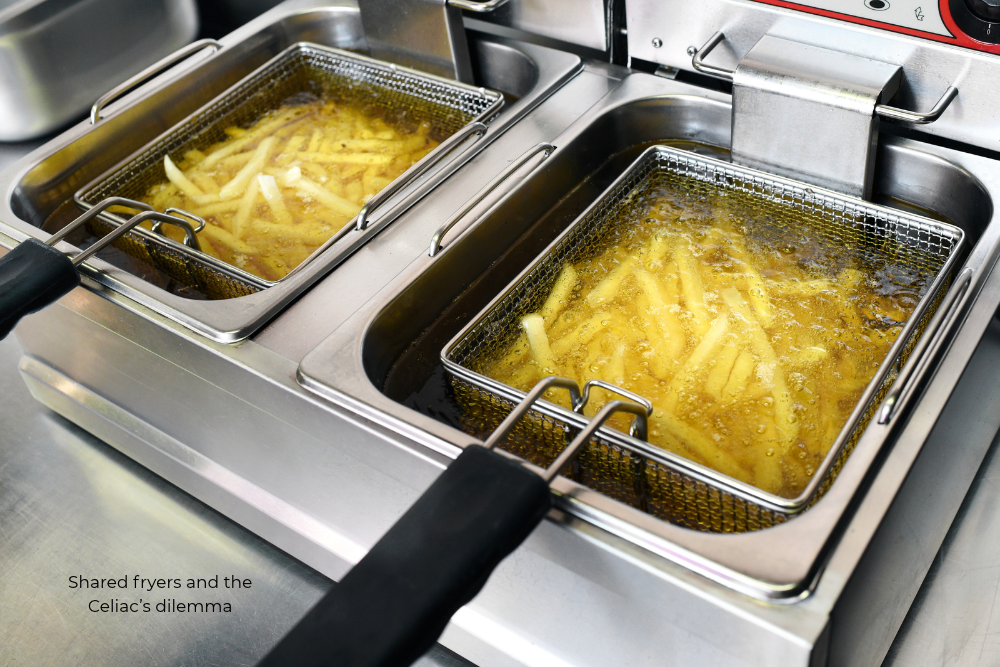
If you have celiac disease, you’ve probably been told to avoid French fries cooked in a shared fryer. And for good reason. When restaurants fry potatoes in the same oil as breaded chicken, onion rings, and other gluten-containing foods, there’s a risk that stray bits of gluten can make their way into your food.
But have you ever wondered how much gluten actually ends up transferring to your fries? And is every shared fryer equally risky?
A new study led by the Celiac Disease Foundation tested foods cooked in shared fryers at restaurants across the United States, and the results are surprisingly encouraging!
I was invited to a private briefing with the Celiac Disease Foundation and the researchers behind the study, where we discussed the findings and what they mean for people living with celiac disease.
The big takeaway? Shared fryers aren’t automatically safe, but they may not all carry the same level of risk.
And for a community that already has so many food restrictions, it’s worth understanding the risks so we can decide what works, and doesn’t work, for our own unique situations.
What Did the Study Find?
Researchers collected 98 samples of naturally gluten-free foods cooked in shared fryers at restaurants, including fast-food chains, across 14 states. The samples included 55 orders of French fries and 43 orders of tortilla chips. All the foods were prepared in fryers that also cooked gluten-containing foods.
Researchers tested the samples using a method called ELISA, a laboratory test that detects and measures gluten proteins in food. Specifically, they used the R5 sandwich ELISA method, which is commonly used in gluten testing.
Here’s what researchers discovered:
- 93.9% of all samples (92 out of 98) measured below 20 parts per million (ppm) of gluten.
- All 43 tortilla chip samples measured below 5 ppm of gluten.
- 89.1% of French fry samples measured below 20 ppm, with six of the 55 samples exceeding that threshold.
For context, the FDA requires foods labeled gluten-free to contain less than 20 ppm of gluten. While that doesn’t guarantee a particular restaurant meal is safe for someone with celiac disease, it’s a useful benchmark for understanding these results.
It’s also important to understand that this study measured gluten levels in food, not whether eating those foods caused symptoms or intestinal damage in people with celiac disease.
This is encouraging news, especially when eating out. After all, even when you ask whether a fryer is dedicated gluten-free, a server might give you incorrect information, or mistakes can happen in a busy kitchen.
And of course, seeing that six French fry samples exceeded 20 ppm reminds us that gluten cross-contact can still happen in a shared fryer.
The way I see this research isn’t that this new study is suggesting we all start eating from shared fryers or that there’s zero risk. Rather, the findings suggest the risk may be lower in some situations than we once thought. And that’s encouraging! The goal is to help people with celiac disease better understand the risks and make informed decisions that work for their individual circumstances.
Does It Matter How Often Restaurants Change Their Fryer Oil?
This new research found that none of the 39 samples collected from restaurants reporting daily oil changes measured 20 ppm or higher.
By comparison, four of the 35 samples from restaurants reporting weekly oil changes measured at or above 20 ppm.
That doesn’t mean a daily oil change guarantees your fries will be gluten-free. But the difference was statistically significant, suggesting that how often restaurants change their fryer oil may influence gluten cross-contact risk.
So, if you’re in a situation where you really want those French fries, but the restaurant uses a shared fryer, you could ask your server how often the oil is changed. If it’s changed daily, that’s one more piece of information to consider when deciding whether the reward of eating those fries outweighs the risk of getting glutened.
You can also ask what other foods are cooked in the fryer. For example, is the restaurant frying breaded chicken tenders, mozzarella sticks, or onion rings alongside the fries? Or is the fryer primarily used for naturally gluten-free foods, with only occasional gluten-containing items?
Knowing what else goes into the fryer may help you better understand the potential for cross-contact, although this study didn’t establish which specific combinations of foods are safer.
So instead of only asking whether a fryer is shared, you might also ask your server:
- How frequently is the fryer oil changed?
- When was the oil last changed?
- What other gluten-containing foods are cooked in the fryer?
These questions won’t guarantee a gluten-free meal, but they may help you better understand the risks and make a decision you’re comfortable with.
More Food for Thought: What Does Earlier Research Tell Us?
While the new study offers encouraging findings, it’s not the first time researchers have looked at gluten cross-contact in shared fryers.
And when you look at the research together, there are a few important considerations worth understanding.
Earlier Research Also Found Gluten Cross-Contact in Shared Fryers
In a 2021 pilot study, Gluten Free Watchdog tested 20 orders of French fries cooked in shared fryers. Five of the 20 orders (25%) tested at or above 20 ppm of gluten, while the new Celiac Disease Foundation study found six of 55 French fry samples (10.9%) exceeded 20 ppm.
Both studies found that most French fry orders measured below 20 ppm, but some contained higher amounts of gluten.
The percentages are different, but the studies involved relatively small numbers of samples collected under different conditions. We can’t conclude from these results alone that shared fryers have become safer or that one study cancels out the other.
My takeaway: Gluten cross-contact is a real risk, but it doesn’t appear to happen at the same level in every shared fryer.
Deep Frying May Make Gluten Harder to Detect
A 2025 study led by researchers from the FDA and Florida State University found that gluten became harder to detect after prolonged exposure to high frying temperatures.
In their laboratory experiments, researchers observed that the amount of gluten detected by an R5 ELISA test decreased as heating time increased. This matters because the new Celiac Disease Foundation study also used an R5 sandwich ELISA test. Could the high frying temperatures have affected the results, causing some samples to contain more gluten than the tests detected? It’s possible.
It’s possible. But it’s important to note that the 2025 research was conducted under controlled laboratory conditions, not real-world conditions, so we don’t know how much, if at all, this would have affected the results of the new restaurant study.
And it also means we still have questions about how accurately gluten can be measured after deep frying and if it’s temperature dependent.
Gluten Can Accumulate in Fryer Oil Throughout the Day
Remember how the new study found lower measured gluten levels at restaurants reporting daily oil changes? Well, earlier research gives us another reason to think about how fryer oil is used.
In that same 2025 FDA-led laboratory study, researchers found that detectable gluten in frying oil increased as more batches of breaded shrimp were cooked.
After one batch, the oil contained approximately 51 ppm of detectable gluten. After ten batches, that number increased to approximately 260 ppm.
In other words, even if a restaurant changes its oil every morning, that doesn’t tell us how much gluten-containing food has been cooked in it by dinnertime.
This is why I think asking when the oil was last changed, and what else has been cooked in it, could be just as helpful as asking how often it’s changed.
Again, these questions won’t guarantee safety, but they may provide additional context.
The Type of Food and Portion Size Matter, Too
Another interesting finding from the 2025 laboratory research was that different foods absorbed different amounts of gluten from contaminated fryer oil.
Researchers tested French fries, tater tots, and chicken pieces, and found that the amount of gluten transferred varied by food.
That may help explain why gluten cross-contact isn’t necessarily the same for every food cooked in a shared fryer, although it doesn’t tell us why all the tortilla chips in the new study measured below 5 ppm.
And there’s something else to consider: The amount of gluten you consume depends on how much food you eat.
For example, a 100-gram serving of food containing 20 ppm of gluten would contain approximately 2 milligrams of gluten. A 200-gram serving at the same concentration would contain approximately 4 milligrams.
So even when two foods have the same gluten concentration, the amount you actually consume can be different.
That’s why a result below 20 ppm shouldn’t automatically be interpreted as a guarantee of safety, particularly when we’re talking about restaurant portions that can vary widely.
We’re Still Learning How to Reduce Gluten Cross-Contact
One more 2025 study from FDA and Florida State University researchers looked at whether filtering shared fryer oil could help reduce gluten contamination. Researchers found that finer filtration methods could remove more gluten from contaminated oil under experimental conditions.
Does that mean restaurants can simply filter their oil and make shared fryers safe for people with celiac disease? No. But it does suggest there may be additional ways to reduce cross-contact beyond simply changing the oil.
And that’s what excites me about this research. We’re learning more about what influences gluten cross-contact, which could eventually lead to better restaurant practices and more informed decisions.
My Take: I’m Encouraged by This New Research!
I’ve been living with celiac disease for more than 14 years, and one thing I’ve learned is that gluten cross-contact isn’t always as black-and-white as people make it out to be.
For example, I don’t automatically avoid packaged gluten-free foods just because they’re manufactured in a shared facility or on shared equipment. I look at the product, its labeling, and the precautions taken.
Restaurants, however, have always felt a little different because we don’t have the same visibility into how our food is prepared. That’s why I’ve always avoided shared fryers.
But I also know how frustrating it can be to sit at a restaurant watching everyone else scoop their chips in salsa while you dip your crunch down on carrot sticks.
So yes, as someone who’s been managing celiac disease for more than 14 years, I’m excited that researchers decided to tackle these questions and share what I consider hopeful findings.
Does this mean I’m going to start ordering French fries from every shared fryer? No. But I might consider ordering the tortilla chips and salsa, who knows! I may ask more questions before making that decision, like: How recently was the oil changed? What else has been cooked in it? Is this a restaurant where gluten-containing foods are constantly going into the fryer?
I may not always get perfect answers, and I may still decide the risk isn’t worth it. But at least I’d be asking better questions.
Personally, I don’t want to avoid foods unnecessarily or fall into the trap of what some call being “too gluten-free.” I want to make informed decisions based on good science.
And I think that’s what makes this study so valuable, even though there are still plenty of gray areas to navigate and everyone’s risk tolerance is different.
I’m all for being careful, but I’m also all for using science to better understand where we actually need to be careful.
The Bottom Line
This new research from the Celiac Disease Foundation found that French fries and tortilla chips cooked in shared fryers often measured below 20 ppm of gluten, suggesting that gluten cross-contact in shared fryers may not be as black-and-white “off-limits” as we once thought.
But earlier research also reminds us that gluten can accumulate in fryer oil, high temperatures may affect how accurately we can measure gluten, and the amount of gluten transferred can vary depending on the food and cooking conditions.
The bottom line is that shared fryers aren’t automatically safe, but they also may not carry the same level of risk either.
These findings can feel confusing and even contradictory at times, but my two cents is that everyone in our community needs to do what feels right for them.
For some people, not being able to enjoy the chips and salsa or French fries at a restaurant is genuinely upsetting. And I don’t think anyone should shame them for weighing the findings of this study, asking a few follow-up questions, and making a personal decision about whether they’re comfortable taking that risk.
For others, the possibility of gluten cross-contact simply isn’t worth it. They’d rather seek out restaurants with dedicated gluten-free fryers and skip the rest. I completely understand that side of the coin, too.
Neither decision needs to become a debate about who’s doing gluten-free the “right” way.
I’m encouraged that researchers are looking more closely at this issue and helping us understand where the real risks lie.
Because living gluten-free is restrictive enough. If science can help us feel more confident about eating some of the foods we’ve been avoiding, or simply make us feel a little more comfortable eating out, I’m all for it!
Sources
Jiang et al., Evaluation of Gluten Transfer from Reused Frying Oil to Food, Food Control (2025)
Disclosure: I attended a private research briefing hosted by the Celiac Disease Foundation. I was not involved in conducting the study or compensated in any way.
Leave a Comment